
What a tier actually is
A VIP tier is a discount band on trading fees, assigned automatically from measurements the exchange takes of your account. It is not a status you apply for, not something support can grant, and not something that persists because you once qualified. It is the output of a calculation that runs again on a schedule.
Two inputs go into that calculation on most platforms: how much you traded over a recent window, and how much of the exchange's own token you were holding when the snapshot was taken. Both are re-measured every cycle. Neither remembers last month.
That single fact — recomputed, not awarded — explains almost every confused question about tiers. A tier does not decay, expire or get taken away. It is simply recalculated, and this time the answer came out lower.
How the assessment works
The general shape is the same across major platforms even where the details differ:
- A trailing volume window. Typically the last 30 days, counted in a common currency, and rolling — the day that just dropped off the back end is gone whether or not you noticed.
- A balance condition, measured at a moment. Not an average across the month. A snapshot. Being above the threshold most of the time and below it on assessment day gives the same result as never having been above it.
- A recalculation on a schedule, usually daily, applying from a stated time. Your rate can therefore change without you having done anything that day.
- Volume measured across an account group, including sub-accounts on most platforms — which is why splitting activity across sub-accounts does not lose you volume, but opening a genuinely separate account does.
What does not count is as important. Deposits do not count. Holding does not count. Internal transfers do not count. Some product categories are excluded from the volume calculation entirely, and the exclusions are listed on the platform's own rules page rather than inferable from the interface.
Why "and" is the word that matters
Read the conditions column of a real fee table and one word does most of the work.
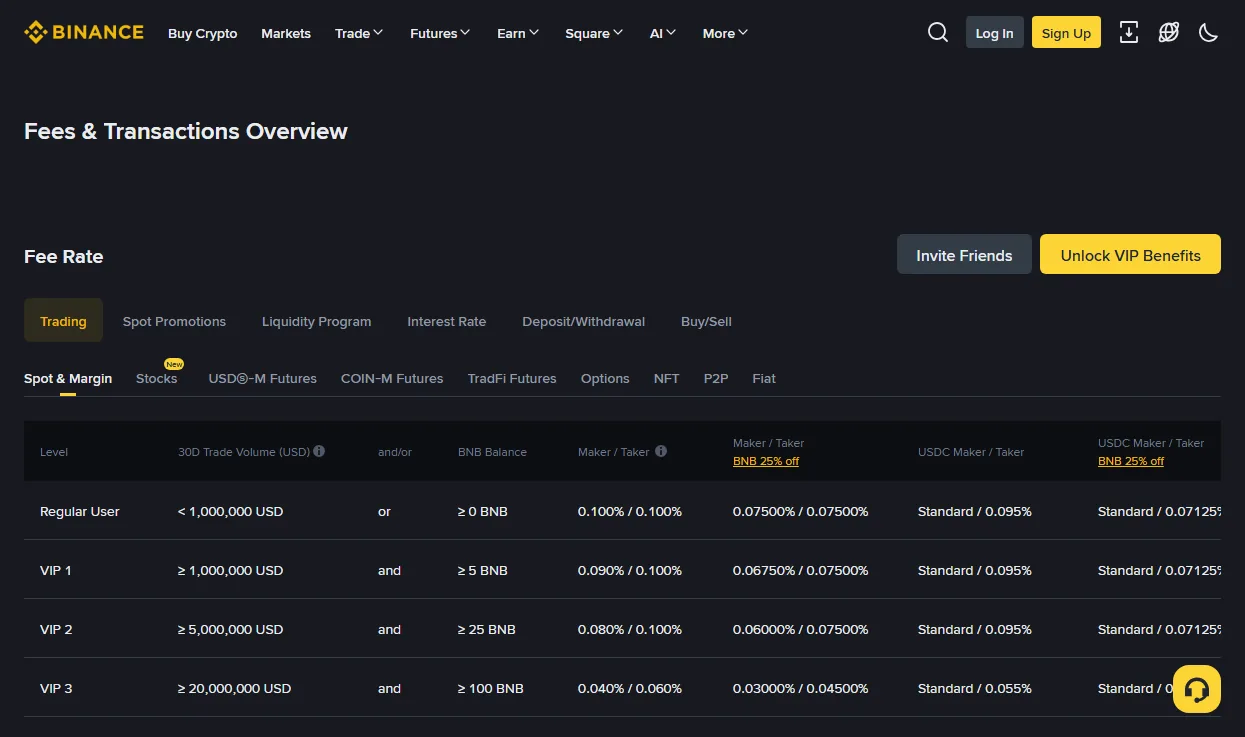
On the capture above, the base row asks for volume under a threshold or a token balance of zero and up, which is a way of saying everyone qualifies. Every tier above it asks for the volume threshold and the token balance. Both, at once, at assessment time.
This is where most people's expectations break. Volume is the number that gets discussed, so it is the number people track — and then the tier does not arrive, because the balance condition was never met. The two conditions are not alternatives and they are not weighted against each other. Missing either one puts you on the row below.
It is also worth reading the rate columns rather than just the tier names. On the same capture, moving from the base row to the first VIP tier changes the maker rate but leaves the taker rate unchanged. If your orders are mostly takers — and market orders always are — that first tier buys you nothing at all on the trades you actually place.
Why a tier drops
Four causes, in rough order of how often they surprise people:
- A busy month rolled out of the window. The volume that earned the tier is now older than the window and no longer counts. Nothing was taken from you; the measurement moved.
- The token balance fell below the threshold on assessment day. Often because the token's price fell rather than because you sold any of it — a balance requirement denominated in tokens still moves in value, and a requirement denominated in value moves in tokens.
- You used the token to pay fees, which slowly reduces the balance that qualifies you for the discount you are using it to get. This is a genuinely circular trap and it catches careful people.
- The rules changed. Thresholds are set by the platform and revised. A tier held for a year can end without any change in your behaviour.
None of these are reversible by contacting support, because none of them are errors.
Spot and futures are not the same tier
A detail that costs people real money: on most platforms the spot fee tier and the derivatives fee tier are assessed separately, with different volume ladders and sometimes different rules about what counts. Reaching a tier on one side does not move the other.
The practical consequence is that a trader who does most of their volume in derivatives may be at a good tier there and the base tier on spot, and will be paying base-tier rates on the spot conversions they use to move money around. Check both tables rather than assuming one number describes your account.
Is chasing a tier worth it?
Do the arithmetic before deciding, because it is not close.
Suppose the first tier requires a million in trailing 30-day volume, and suppose it improves your maker rate by one hundredth of a percentage point. The saving is that improvement multiplied by your volume: one million times 0.0001 is one hundred. Now suppose you were naturally going to trade a quarter of that. To reach the threshold you have to execute an extra three-quarters of a million in volume, and every one of those trades pays the fee you are currently on — plus the spread, twice, on each round trip.
The added fees exceed the saving by a wide margin, and that is before counting the market risk of trades you had no other reason to place. The conclusion generalises: at every tier, the volume required to move up costs more in fees than the improved rate gives back, unless you were going to trade that volume regardless.
Where tiers do matter is the opposite direction. If you are already trading at a level that puts you near a threshold, then knowing where the threshold is — and holding the balance condition — turns volume you were producing anyway into a lower rate. That is worth five minutes of attention. Manufacturing the volume is not.
If you want the comparison on your own numbers rather than these, the fee comparison tool takes your monthly volume and shows the four combinations side by side.
The levers that work without volume
Three things move your effective rate and none of them require trading more.
- Paying fees in the exchange token. On the capture above this is a flat percentage off, available at every row including the base one. It is the single largest discount most accounts will ever get, and it applies from your first trade.
- Placing maker orders instead of taker orders. A limit order that rests on the book pays the maker rate; a market order never does. On many tiers this difference is larger than a whole tier step.
- Having a referral relationship attached to the account. It is set at registration and cannot be added later, which is the one thing about it worth knowing in advance.
All three are available on day one at the base tier, which is the honest headline of this article: the discounts you can actually control are not the ones with tier numbers attached.
Things people get wrong
- "VIP is permanent once reached." It is a recalculation, not an award.
- "Holding the token is enough." Above the base row, both conditions must hold together.
- "Volume includes deposits and transfers." It does not. Only executed trades in the counted categories.
- "Support can grant a tier." They cannot, and anyone offering to is not support.
- "One tier covers the whole account." Spot and derivatives are assessed separately.
- "The tier is the biggest lever on my fees." For almost every retail account, the token discount and maker-versus-taker matter more.
How to check where you actually are
Three places, in this order:
- Your own fee page inside the account. It shows the tier you are currently on, and usually the trailing volume figure the platform is measuring — which is the number to trust over your own arithmetic.
- The public fee schedule. It shows the thresholds and the rates, and it is the page that changes when the rules do. Bookmark it rather than a summary of it.
- Your trade history export. The only way to see what you actually paid rather than what you should have paid. Fees appear per fill, and the total is often a surprise for reasons that have nothing to do with tiers.
Questions people ask afterwards
How often are tiers reassessed?
On most platforms daily, applying from a stated time. Because it is a rolling calculation rather than a monthly reset, there is no date on which you are safe — the window moves every day.
Does the balance condition have to hold all month?
Typically no, only at the assessment moment. In practice that makes it harder rather than easier, because a balance you happen to be below at the wrong hour costs you the tier for the next cycle.
I dropped a tier and my volume has not changed. How?
Almost always the balance condition, and almost always because the token's price moved rather than because you sold. Check the balance requirement in whichever unit it is denominated in — that is where the change happened.
Does the referral discount stack with the tier and the token discount?
They are separate multipliers, so yes, in the sense that they all apply to the same trade. The order they are applied in and the exact interaction are set by the platform and stated on its fee page; the fee comparison tool shows the combinations rather than describing them.