
The four multipliers
The rate applied to a trade comes from four inputs, applied together:
| Input | What sets it | Can you move it? |
|---|---|---|
| Base tier | Rolling trading volume and, on some tiers, a token balance requirement | Not in the short term. This is a volume game. |
| Maker or taker | Whether your order sat in the book or hit an existing one | Yes — it is a consequence of your order type |
| Fee-token discount | Whether you have opted to pay fees in BNB | Yes, it is a switch in settings |
| Referral rebate | Whether a referral relationship was bound at sign-up | Only at account creation. Never after. |
Deliberately no numbers in that table. Every one of these values differs by region, product line and period, and a number written into an article is a number that will be wrong within months. The fee comparison tool lets you put your own values in and see the four combinations side by side.
Maker and taker, and a correction we had to make
A maker order adds liquidity: it sits in the order book waiting. A taker order removes it: it executes immediately against what is already there. In practice, a limit order priced away from the market is usually a maker; a market order is always a taker.
The word doing the work there is "usually". On the entry tier the two rates are frequently the same number, and the published fee schedule is where you can check it for the tier you are actually on.
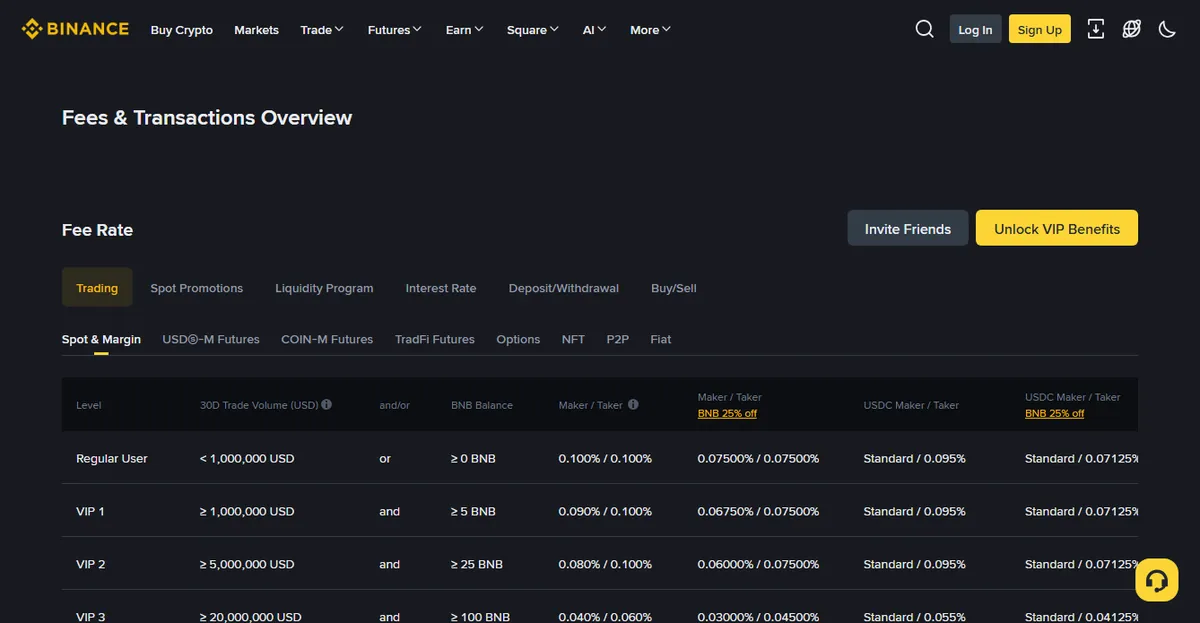
So the accurate statement is: the maker rate is usually at or below the taker rate, and the gap widens as you go up the tiers. At the entry tier the two are commonly the same, which means the practical advice most sites give — "use limit orders to save on fees" — saves the average new user nothing at all on the fee line.
It can still be worth doing, for a different reason. A limit order controls your execution price; a market order does not. On a thin book, the difference between the price you saw and the price you got can dwarf any fee. That is a real argument for limit orders. The fee saving, at the entry tier, is not.
Paying the fee in BNB
The platform offers a discount if you let the trading fee be deducted in its own token rather than in the asset traded. It is a toggle, and it applies going forward, not retroactively.
The part that is usually left out: this converts a fee into a position. To use the discount you have to hold a balance of the token, and that balance has its own price risk. If the discount is a fraction of a percent per trade and the token drops meaningfully while you hold it, the arithmetic can easily run the wrong way.
Our position: it is worth switching on if you trade often enough that fees are a visible line in your account, and you hold only roughly what you will consume in fees over a reasonable horizon. It is not worth buying a large balance to "lock in" a discount — that is not a discount, it is a directional bet with a rebate attached.
The referral rebate
A referral relationship, bound at registration, returns part of the referrer's commission to you in the form of a reduced fee. It is not an extra charge and it is not paid by you; it is a share of what the platform pays out.
Two things that matter more than the percentage:
- It is bound at account creation and cannot normally be added later. If you already have an account, this section does not apply to you and no code on any website will change that.
- Its shape is set by the platform and changes. Not just the number — whether it is a percentage at all. Whatever figure a site quotes, including this one, take what your own registration page shows as the real one.
Concretely: in September 2026 the public campaign page is not a flat percentage. It has two tabs, one for vouchers and one for the commission split. The voucher side quotes up to $1,000 for the referrer and up to $1,100 for the invited side, with conditions attached — the invited person has to buy more than $50 of crypto and complete more than $100 of spot or convert trading before the vouchers count. Both figures are ceilings, not what lands in the account on sign-up. The large percentage on the other tab is what the referrer earns, not what you get.

This site's invite code is BNB608
Registering with it gets you whatever fee rebate Binance is running for new users at that moment. Percentage or voucher, how much, and whether it requires you to fund and trade first — all of that is on their page on the day you sign up, not ours. Typing the code into the referral field yourself does exactly the same thing.
Go to the Binance registration page
This is a referral link, and this site earns from it. Using it is optional and the manual code does the same job. We do not promise any figure. The screenshot above is everything visible without logging in; past that point you have to look for yourself. This site is not Binance; the full revenue structure is on the disclosure page.
The rate is different on every product line
People talk about "the fee" as though an account has one. It has several, assessed separately, and the tier you hold on one does not carry across to another.
- Spot. The table everyone quotes. Maker and taker, tiered by rolling volume.
- Margin. The same trading fee as spot, plus interest on whatever you borrowed, accruing hourly for as long as the loan is open. The interest is the part that gets forgotten, because it does not appear on the trade.
- Derivatives. A separate fee ladder with its own volume assessment, plus funding on perpetual positions, plus a liquidation fee if it comes to that. Three costs where spot has one.
- Convert and quick-buy. Usually shown as "no fee". The cost is in the quoted rate rather than on a fee line, and comparing that quote to the spot mid price at the same moment is the only way to see it.
- Card purchase. A processing fee plus a pricing spread, and the most expensive route in every market we have looked at.
- P2P. Often zero explicit fee, which is a current policy rather than a property of the model. The counterparty's margin is already inside the listed price.
The practical consequence: if you are comparing "which platform is cheaper", compare the product line you actually use. A platform with an excellent spot table and an expensive convert flow is expensive for someone who only ever uses convert.
The costs that are not in the fee table
This is the section that matters most, and it is the one nobody optimises.
The spread
The gap between the best bid and the best ask is a cost you pay on entry and again on exit, and it does not appear on any fee schedule. On a liquid pair it is negligible. On a thin one it can be several times the trading fee. If you trade small-cap pairs, this is your dominant cost and the fee tier is a rounding error.
Withdrawal fees
Set per asset and per chain, and often the largest single number an occasional user ever pays. We used to describe these as the platform "passing on" the network cost. That was misleading: the platform sets and adjusts this price itself with reference to network conditions, and the two do not have to be equal. Which chain you pick is the lever here, and it is covered in which chain to withdraw on.
Conversion and quick-buy pricing
One-click conversion and card purchase flows usually show no explicit fee. The cost is inside the rate you are quoted. The way to see it is to compare that quote against the mid price on the ordinary trading page at the same moment — the difference is what the convenience costs, and it is normally far more than the fee table's worst row.
Funding, if you hold derivatives
On perpetual contracts, funding is charged periodically for as long as you hold, and for a multi-day position it routinely exceeds the round-trip trading fee. It also quietly moves your liquidation price. See the funding rate.
P2P pricing
Whether a P2P market charges an explicit fee depends on the market and the pair — a zero-fee P2P market is a current policy in some places, not a property of the model. Read the order screen. Separately, the price in the listing already contains the counterparty's margin, which is the real cost regardless of what the fee line says.
A worked example, with the layers in order
Numbers are deliberately absent from the rest of this page, because published rates go stale. But the structure does not go stale, and the structure is easier to see with example values than with prose. So: pretend the base spot rate on your tier is B, and work through what actually happens to it.
- Start at your tier's rate. Not the rate in a screenshot, and not the rate on the marketing page. The rate on your own fee page, which reflects your rolling volume and any balance condition attached to your tier.
- Apply maker or taker. At the entry tier these are frequently the same number, so this step often changes nothing at all. Further up the table it does. This is a multiplication, not a subtraction.
- Apply the fee-token discount, if the toggle is on. Another multiplication, applied to the result of step two rather than to the base rate. This is why people who add the percentages together get an answer that is too generous.
- Apply the referral rebate, if one is bound. Again a multiplication on what is left. And note where it sits: last, on an already-discounted number, which makes its absolute effect smaller than the headline percentage suggests.
- Then add the things that are not in this chain at all. The spread you paid on entry. The spread you will pay on exit. The withdrawal fee at the end. None of these is touched by any of the four steps above.
The reason to lay it out this way is that it makes one thing obvious that fee comparisons usually hide: the four multipliers act on each other, and the costs in step five do not care about any of them. For an ordinary user trading occasionally, the sum of the step-five items is routinely larger than everything steps one to four can save. That is not an argument for ignoring fees. It is an argument for not stopping there.
What actually moves the number, by kind of user
Generic fee advice fails because it is written for a user who does not exist. Three sketches, and the honest answer for each:
You buy occasionally and hold
Your trading fee is close to irrelevant. Two or three trades a year at any tier is not where your money goes. What does matter: the withdrawal fee when you move the asset off the platform, and the spread on any quick-buy or conversion flow you used to get in. Optimise those two and ignore the tier table entirely.
You trade regularly in modest size
This is the group for whom the four multipliers are actually worth configuring — and, specifically, the two that are free. The fee-token toggle costs a settings change. The referral relationship costs nothing at all but has to be set at registration. Chasing a higher volume tier, on the other hand, is usually backwards: trading more to pay a lower rate on more trading is a way to spend money, not save it.
You hold derivative positions overnight
Then the trading fee is not your main cost and the tier table is a distraction. Funding is charged periodically for as long as the position is open, and over several days it routinely exceeds the round-trip trading fee by a wide margin. Read the funding rate before you read anything else about fees.
How to check what you are actually paying
Three checks, in increasing order of usefulness:
- Your fee tier page. Shows your current tier and rates. This is the only authoritative source for your account, and it takes ten seconds.
- The transaction history. Every filled order records the fee actually charged and in which asset. This is where you find out whether the BNB discount is really applying — a surprising number of people have the toggle off.
- Total cost on a round trip. Take one buy and its matching sell, and compare what you spent to what you got back, ignoring price movement. That number includes the spread, and it is the only figure that reflects what trading actually costs you.
The third one is the honest measure and almost nobody does it, because the first two are flattering and easy.
Questions people ask afterwards
Does the BNB discount apply to withdrawal fees?
It applies to trading fees. Withdrawal fees are set per asset and per network and are a separate charge, which is why picking the right chain saves more than the token discount does for an occasional user.
Why is the fee on my trade in a different asset than I expected?
Because the fee is charged in whichever asset the platform deducts it from — the asset received, or the fee token if the discount is on. The transaction history records both the amount and the asset for every fill.
Is a limit order always cheaper than a market order?
Not at the entry tier, where maker and taker rates are frequently the same number. It is usually cheaper in total cost, because a limit order controls your execution price and a market order crosses the spread — but that saving is not on the fee line.
Do fees differ by country?
They can, because different regional entities publish different schedules, and some product lines are unavailable in some markets. Your own fee page is authoritative; a schedule you found through a search may belong to a different entity.
What is the single cheapest change I can make?
For an occasional user, choosing the right withdrawal network. For a regular trader, turning on the fee-token discount. Neither is the tier table, which is the thing most articles about fees are actually about.
Sources
- Binance, fee schedule — the published spot and derivatives rates by tier, and the source of the screenshot above. This is the page to check rather than any figure in an article.
- Your own fee page inside the account. Regional entities and product lines differ, and the tier the platform has you on is the only one that applies to you.
- Binance, referral campaign page — the source of the screenshot above, and the only public evidence of what the referral layer currently looks like. That link carries no referral parameters and earns this site nothing.
- Binance, official help centre — for how the fee-token discount and referral rebate interact on a specific account.
This page deliberately contains no rate figures other than in the screenshot, which is dated. Rates change, and a number written into an article ages into a wrong answer that still reads as authoritative.