
What the product page is actually telling you
Before the mechanics, it is worth looking at how one of these pages presents itself, because the presentation is doing a lot of work.
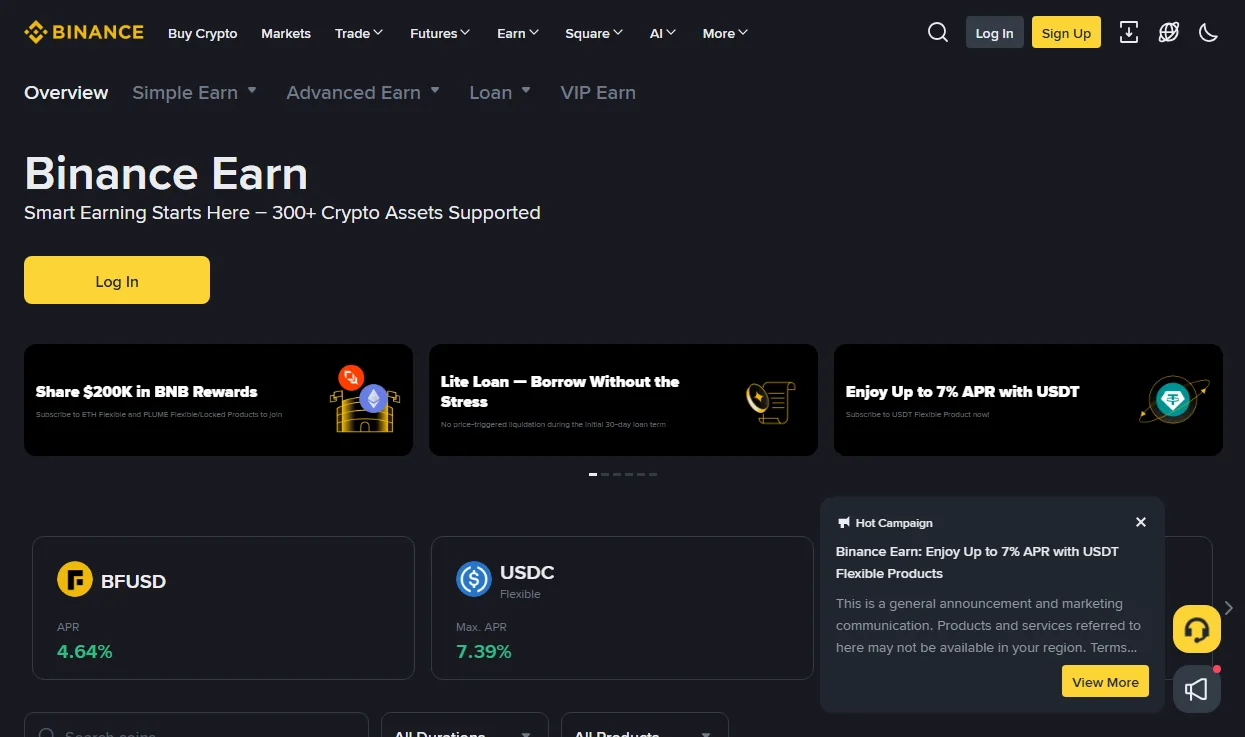
The word "Earn" is a category label covering products with almost nothing in common: some lend your asset to margin traders, some stake it on a network, some subscribe you to a structured product with a payoff that depends on price, and some are loans where you are the borrower rather than the lender. They share a page, a design language and a unit of measurement, and that shared surface is the source of most of the confusion in this subject.
Notice also which numbers are prominent. A "Max APR" is the rate at the best tier, on the smallest permitted balance, sometimes for a promotional window. The rate you would actually receive on the amount you would actually deposit is usually a click away and always lower.
Where the yield actually comes from
Every honest yield has a payer. Four broad sources cover almost everything on a page like the one above:
- Lending to leveraged traders. Your asset is lent to people who borrow to trade with margin, and they pay interest. The yield is real and it is funded by trading demand — which means it falls when markets go quiet, and the borrowers are, by construction, the most leveraged participants in the market.
- Network staking. The asset secures a proof-of-stake network and the protocol issues rewards. The rate is set by the network. The catch is the unbonding period, which is a property of the protocol and cannot be waived by the platform, and slashing risk if the validator misbehaves.
- Structured products with a price condition. Dual-currency and similar products pay a high headline rate in exchange for you accepting one of two outcomes depending on where the price lands. The rate is not interest; it is closer to a premium for writing an option, and the "risk" is not a tail event but the ordinary case that the price moves.
- Marketing. A promotional rate paid out of the platform's budget to acquire deposits. Genuinely available, genuinely temporary, and usually capped at a small principal.
If a product's page does not let you work out which of these four it is, that is itself the finding. Every legitimate product will tell you, usually in a rules or FAQ link below the fold.
Denominated yield is not a return
This is the mistake that costs the most money and is the least discussed.
A product paying 8% on a token pays you 8% more of that token. If the token is a stablecoin, that is close to a return in the ordinary sense. If it is a volatile asset, the yield and the price move independently, and the price movement is almost always the larger term. Ending the year with 8% more of something worth 30% less is a loss, and the product performed exactly as advertised throughout.
The way to read any rate is therefore to ask what it is denominated in, and then to compare it against simply holding the same asset. In many cases the honest description of a yield product on a volatile token is "a long position with a small coupon attached", and that is a very different thing from a savings product.
APR, APY, and the number that is neither
Three numbers get used interchangeably on these pages and they are not the same.
- APR is the simple annualised rate with no compounding assumed.
- APY assumes the rewards are reinvested at the same rate for a year. The gap between the two grows with the rate, which is why the more aggressive the product, the more likely it advertises APY.
- The observed rate, which on flexible products is variable, recalculated frequently, and shown as a current snapshot. Nothing about it is promised for tomorrow.
A high APY on a flexible product is a projection built on two assumptions — that the rate holds and that you compound — and neither is guaranteed. On a locked product with a fixed rate, the number is closer to a commitment, and the cost of that certainty is the lock-up.
What a lock-up really costs
A locked product pays more because you have given up the ability to act. The cost of that is not the difference in headline rates; it is what happens in the scenarios where you would have wanted your asset back.
Three of those scenarios come up repeatedly: the market falls sharply and you cannot sell; the platform has an incident and you cannot withdraw; you need the money for something unrelated to markets entirely. A lock-up converts a liquid holding into an illiquid one for the duration, and the extra percentage point or two is the price you were paid for that.
Early redemption, where it exists, usually forfeits accrued rewards and sometimes charges a fee. Read that clause before subscribing rather than during the event that makes you want it — and note that on staking products, the unbonding period is imposed by the network and no early-exit button can shorten it.
Why the best rate applies to the smallest amount
Almost every flexible product is tiered: a high rate on the first slice of principal, a much lower rate above it. The advertised figure is the first tier.
The practical effect is that the blended rate on a meaningful deposit is far below the headline. Someone reading "up to 7%" and depositing ten times the first-tier cap may be receiving something closer to 2% overall — not because anything was hidden, but because the cap is stated in the product details rather than on the card.
Before subscribing, find the tier table and compute the blended rate on the amount you actually intend to deposit. If the product does not publish one, that is worth noticing too.
The risk that applies to all of them
Whatever the mechanism, subscribing means the asset is no longer simply sitting in your account. It has been committed to a product, and getting it back requires the platform to process a redemption.
In normal conditions this is invisible. In abnormal conditions — a platform under stress, a network incident, a regulatory action — it is the whole story, and historically the products that suspended redemptions first were the ones offering the highest rates. That correlation is not a coincidence: the highest rates were funded by the least robust mechanisms.
There is no deposit insurance here in the sense that a bank has it. Whatever the marketing copy says about funds being protected, read the terms for what is actually promised, and treat "we have never had an incident" as a description of the past rather than a property of the product.
Borrowing against your holdings
Loan products sit on the same page and invert the relationship: you are the borrower, your holding is the collateral, and the platform can sell it if the collateral ratio falls too far. This is a leveraged position wearing different clothes.
The specific claim to read carefully is any promise of a period without price-triggered liquidation. Such terms exist and can be genuine, but they are bounded — by a term length, by a rate that applies afterwards, and by the ordinary liquidation rules resuming when the stated window ends. A borrower who reads the promise and not the boundary is exposed on exactly the day the protection lapses.
If you would not open a leveraged position of the same size deliberately, a collateralised loan of the same size is not a safer way to have one.
Four questions before you commit anything
- Who is paying me, and why? Name the payer. If the answer is "the platform", ask out of what.
- What is the rate denominated in, and what does that asset need to do for this to be a gain?
- What is the worst realistic case — not the worst imaginable one? For lending: borrowers default in a crash. For staking: the unbonding period traps you through the fall. For structured: you end up holding the asset you did not want, at the price you did not want.
- How do I get out, how long does it take, and what does exiting early cost? Answer this before subscribing, because it is unanswerable in a hurry.
Words that should stop you
- "Guaranteed", "risk-free", "principal protected" on anything paying more than a bank. Someone is either wrong or being careful with words.
- "Limited quota, ends today." Urgency is a sales technique and it has no business in a decision about where to keep money.
- Rates far above everything else on the same page. Not automatically a fraud, but it is always compensation for something, and you should be able to say what.
- An explanation you cannot repeat back. If you cannot describe the mechanism to someone else in two sentences, you cannot assess it.
Quick answers
Are stablecoin yields safe?
Safer from price movement, not from the mechanism. The yield still comes from lending or from a structured product, and the same counterparty and platform risks apply. You have removed one risk, not all of them.
Why did my rate fall without any notice?
Flexible products are variable by design and recalculate frequently. The rate you subscribed at was a snapshot, not a term. If a fixed rate is what you want, that is what locked products sell, and the lock-up is the price.
Can I lose principal in a flexible savings product?
In the ordinary case no, but "ordinary case" is doing the work in that sentence. The paths to loss are the borrower side defaulting, the platform failing, or the asset itself falling in value. Only the last is visible on a chart.
What happens to a locked product if I need the money?
Read the early-redemption clause before you subscribe. Typically you forfeit accrued rewards, sometimes there is a fee, and on staking products the network's unbonding period applies regardless of what the platform would like to do.