
Why one guide cannot cover four markets
Three things differ between jurisdictions, and each one changes the practical answer:
- Whether a licensed local-currency deposit route exists. If the platform can hold and settle in your currency through a local partner, deposits are ordinary bank transfers. If not, they are not.
- Whether banks cooperate. Even where such a route is legal, individual banks set their own policies about crypto-related transfers, and those policies are not published and not stable.
- What is required of you. Additional verification tiers, source-of-funds documentation and declaration obligations vary and are the part most guides omit entirely.
What follows is a structural sketch of four markets that share a language but not a rulebook. None of it is current regulatory advice, and all of it should be checked against your own account screen and a local source before you act on it. The point is the shape of the differences, not the values.
Start with your own deposit page
Before reading anything about your market, open the deposit screen inside your own account. It is the only page that reflects your entity, your verified country and your account tier at the same time, and it settles most of the questions people ask in forums.
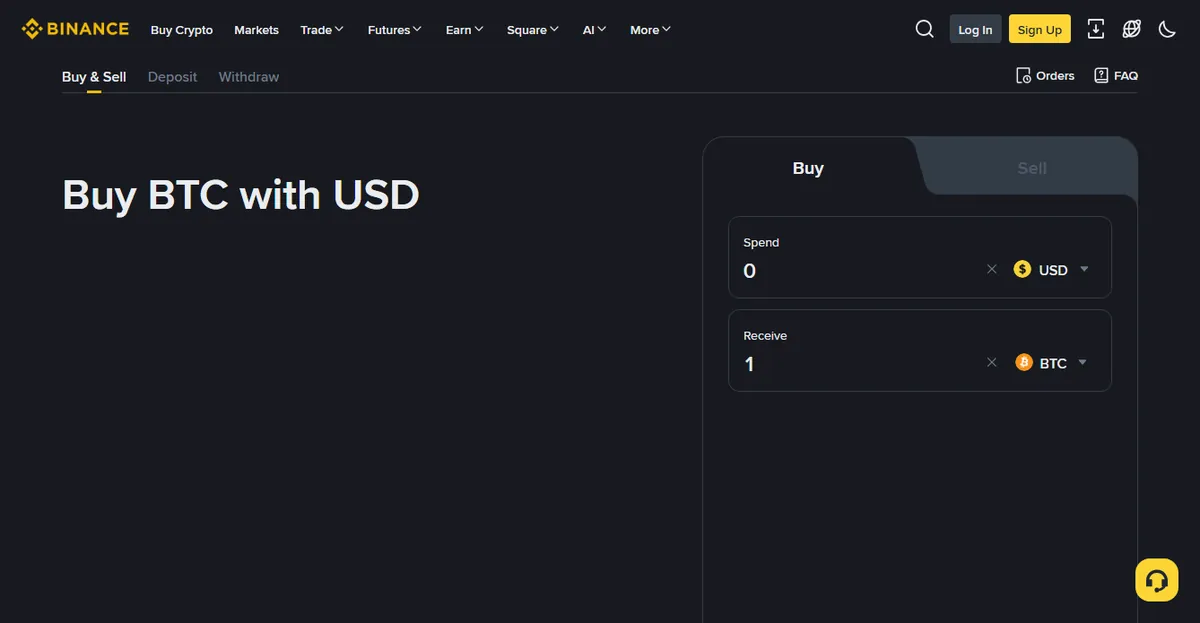
Three readings from your own version of this screen. Which currencies are offered to you at all. Which payment methods appear under the one you want — bank transfer, card, e-wallet, or nothing but P2P. And what each of them states as its limit and its fee before you commit to it. That is the whole market question answered specifically for your account, and it beats any general article including this one.
The four kinds of on-ramp, and what each costs
Across every market in this region, the same four mechanisms appear in different mixes.
- Local-currency bank transfer. Cheapest and most traceable where it exists. Your name is on both ends, the paper trail is clean, and there is no counterparty beyond the platform. This is the route to prefer whenever it is genuinely available for your currency.
- Card purchase. Instant, available almost everywhere, and the most expensive by a wide margin once the processing fee and the pricing spread are counted together. Also the most likely to be declined by the issuer, and a declined card transaction can still place a temporary hold on the funds.
- P2P. The default where no local bank route exists. The platform holds the crypto in escrow while you and a stranger settle the local-currency leg between yourselves, outside the platform's payment system. That last clause is the whole risk, and it is covered in choosing a P2P counterparty.
- E-wallet. Dominant in markets where mobile wallets outnumber bank accounts. Convenient, generally cheap, and the account-name rules matter just as much as with a bank — a wallet transfer feeling casual does not make a third-party payment acceptable.
The general ordering by total cost is bank transfer, then e-wallet, then P2P, then card — but the ordering by risk is different, and P2P moves to the front of that one. Choose on both axes rather than on the headline price.
Singapore
The most institutionally formalised of the four. There is a defined licensing regime for digital payment token services, a regulator that publishes its expectations, and a set of consumer-protection measures that have progressively narrowed what platforms may offer retail customers — restrictions on leverage and on incentives being the visible ones.
Practical shape: local-currency deposit through recognised bank routes is generally the cleanest path where a platform supports it. The trade-off is the other direction from what people expect — the process is more regulated and less flexible, not less. Products available to retail users are a narrower set than in a looser market, deliberately.
Regulatory status, stated plainly. MAS placed Binance.com on its Investor Alert List in September 2021. The group's Singapore entity, Binance Asia Services, had applied for a Major Payment Institution licence under the Payment Services Act; that application was withdrawn, and the local Binance.sg service was closed to Singapore customers. The consequence for a reader here is concrete: there is no MAS-licensed Binance entity holding your money, so the segregation, custody and consumer-protection requirements MAS imposes on licensed digital payment token service providers do not attach to your account. Check the current picture yourself in the MAS Financial Institutions Directory — filter sector "Payments", licence "Major Payment Institution", activity "Digital Payment Token Service", and read who is actually on it.
The thing to check: which entity you actually have an account with, and whether it is the locally licensed one. This determines what you can use and what protections apply, and it is not obvious from the interface.
Malaysia
A market with a clear regulatory perimeter and a well-known consequence: the securities regulator maintains a public list of unauthorised operators, and platforms not recognised locally have appeared on it. That has direct practical effects on which services can be marketed and which local payment routes are willing to serve them.
Practical shape: P2P is the route most people end up using, which puts the material in cash in and cash out squarely on the critical path — receiving ringgit from strangers into a personal bank account is precisely the exposure that article is about. Bank-by-bank policy variation is significant and unpublished.
Regulatory status, stated plainly. This is the market where the gap is widest and where guides most often stay silent. The Securities Commission Malaysia added Binance to its Investor Alert List in July 2020 and, on 26 July 2021, took enforcement action against Binance Holdings and related entities for operating an unregistered digital asset exchange — ordering them to disable the website and apps for Malaysian users, cease all marketing, and shut the local Telegram channel. Binance was later removed from the alert list on the basis that it no longer carried on regulated activity in Malaysia, and Malaysian officials have since restated that it is not permitted to operate there. The recognised route in Malaysia is a Digital Asset Exchange registered with the SC as a Recognised Market Operator; current names sit on the SC's digital assets pages, alongside the alert list.
What that means for you, honestly: in a case shaped like this the enforcement exposure sits with the operator, not with a retail user. But an unrecognised platform is precisely the one your bank has least reason to accommodate, there is no local regulator to complain to, and "the site still loads" is not the same as "this is a supported route". If a registered DAX covers what you need, that is the better default — and we will say so even though it is not what this site earns from.
The thing to check: whether the platform you are using is recognised locally, on the regulator's own list rather than on the platform's marketing. This is a five-minute check with real consequences.
Hong Kong
A licensing framework for virtual asset trading platforms exists and has been operating for several years, with a licensed cohort and a set of retail-access conditions attached to it.
Practical shape: the banking side is generally more workable than in markets without a framework, and local-currency deposit routes exist through licensed operators. The complication is the split between licensed local platforms and global ones: what is available to you depends on which you are dealing with, and the two are not interchangeable.
Regulatory status, stated plainly. The SFC publishes the definitive lists — licensed platforms, applicants, deemed-licensed and closing platforms — at Lists of virtual asset trading platforms. Binance does not appear among the SFC-licensed platform operators. The retail-access conditions, custody and insurance requirements and complaint routes that come with the Hong Kong framework apply to platforms on that list; if you are trading on a global platform from Hong Kong, they do not apply to you.
The thing to check: whether the specific platform holds a local licence, and what that does or does not cover. A framework existing is not the same as your platform being inside it.
The Philippines
A long-established registration regime for virtual asset service providers under the central bank, and one of the region's genuinely high-adoption retail markets — driven substantially by remittances and by e-wallet penetration rather than by trading.
Practical shape: e-wallets are the distinguishing feature. Where a market's dominant payment method is a mobile wallet rather than a bank account, both P2P and direct deposit routes are built around it, and the practical experience is quite different from a bank-transfer market. Fees and limits on those payment routes are their own subject.
Regulatory status, stated plainly. In November 2023 the Philippine Securities and Exchange Commission issued an advisory against Binance — a PDF published on sec.gov.ph, titled “Advisory against Binance” — stating that the platform is not registered in the Philippines and is not authorised to sell or offer securities there, and asking the telecommunications and IT authorities to block access to it. Separately, the Bangko Sentral ng Pilipinas registers Virtual Asset Service Providers, and Binance is not among them. So this is a market where the on-ramp mechanics are unusually easy and the platform's standing is not — and a guide that walks you through e-wallet-to-P2P without saying so has left out the part that matters.
The thing to check: which wallet or bank the counterparty or the deposit route actually uses, and whether the account is in your own name. The third-party payment rule in choosing a P2P counterparty applies with more force here, not less, because wallet transfers feel casual.
Your bank is a separate decision
People treat "is this legal here" and "will my bank allow it" as one question. They are two, and the second one is decided by an institution that publishes nothing.
Bank policy on crypto-related transfers varies within a single market, changes without announcement, and is applied by automated systems that see a pattern rather than a person. The practical consequences are the same everywhere:
- Some banks decline the transfer outright, on either leg. This is a policy outcome, not an error, and appealing it rarely changes anything.
- Some accept it and flag the account for review, which surfaces weeks later as a request for explanation or as a temporarily restricted account.
- Receiving from strangers is the pattern that draws attention, which is why the P2P sell side is where trouble concentrates rather than the buy side.
- Keeping a plain record — what each transfer was, from whom, against which order — is what turns a review into a short conversation. This is the subject of cash in and cash out and it is worth more than any choice of platform.
One consequence worth stating: the account you use for this should not be the account your salary lands in or your rent leaves from. Not because anything improper is happening, but because a review freezes the account, and a frozen account you depend on is a much larger problem than a frozen account you do not.
The four questions to ask about your own market
This is the transferable part. Whatever jurisdiction you are in, including the ones not covered above:
- Is the platform recognised or licensed here, and by whom? Check the regulator's own register, not the platform's claim. This single answer determines most of what follows.
- Does a local-currency deposit route exist for my account? Your own deposit page is authoritative. If a bank transfer option is there for your currency, it is almost always the better route.
- If not, what is my P2P exposure? Which of my accounts receives money from strangers, what happens to me if that account is restricted, and can I explain each transfer? Answer these before the first trade, not after.
- What am I required to declare? Tax and reporting obligations are the part that never appears in on-ramp guides and the part with the longest tail. For anything material, this is a question for a local professional, not a forum.
Our position on the common advice to "pick a jurisdiction with friendlier rules": do not. Using documents or an address that do not correspond to where you actually are converts an ordinary compliance question into a serious one, and it fails at the worst possible moment — when you try to withdraw. The market you live in is the market you are in.
Questions people ask afterwards
Why does my friend in another country have deposit options I do not?
Because the available payment methods are set per market, per entity and per verification tier, and all three can differ between two accounts on the same platform. Your own deposit page is the authoritative answer for you; theirs is authoritative for them.
Is using a platform that is not licensed here illegal for me?
In cases shaped like the ones above, enforcement is aimed at the operator rather than at a retail user, but that is a general observation and not legal advice for your situation. What is certain is the practical cost: no local regulator to complain to, and local banks with less reason to accommodate you.
Can I use a bank account in another country?
Only if it is genuinely yours and your platform account details match it. An account in someone else's name fails the third-party payment rule everywhere, and a mismatch between your verified country and your banking is exactly the pattern that triggers a review at withdrawal.
The rules changed since this was written. Now what?
Assume they have. Every regulator linked above publishes its own current list, and those pages are authoritative where this one is not. If you find something here that is out of date, the contact page reaches us and the change goes into the corrections log.
Sources for the regulatory status sections
- Singapore · Monetary Authority of Singapore, Financial Institutions Directory — linked in the Singapore section above.
- Malaysia · Securities Commission Malaysia, “SC Takes Enforcement Actions on Binance for Illegally Operating in Malaysia” (media release, 26 July 2021, filed under Media Releases on sc.com.my and findable by that title), and the registered DAX and investor alert lists under Digital Assets — the Digital Assets pages are linked in the Malaysia section above.
- Hong Kong · Securities and Futures Commission, Lists of virtual asset trading platforms — linked in the Hong Kong section above.
- Philippines · Securities and Exchange Commission, “Advisory against Binance” (PDF, November 2023), published on sec.gov.ph. Advisories are reissued and superseded; check the SEC’s own advisories index for the current one rather than relying on the date given here.
Lists and enforcement positions are updated by the authorities themselves; the above reflects public information as of 2026-08 and does not update itself. The linked pages are authoritative, this one is not. If you find a discrepancy, tell us through the contact page and it goes into the corrections log.