
What the listing screen is actually showing you
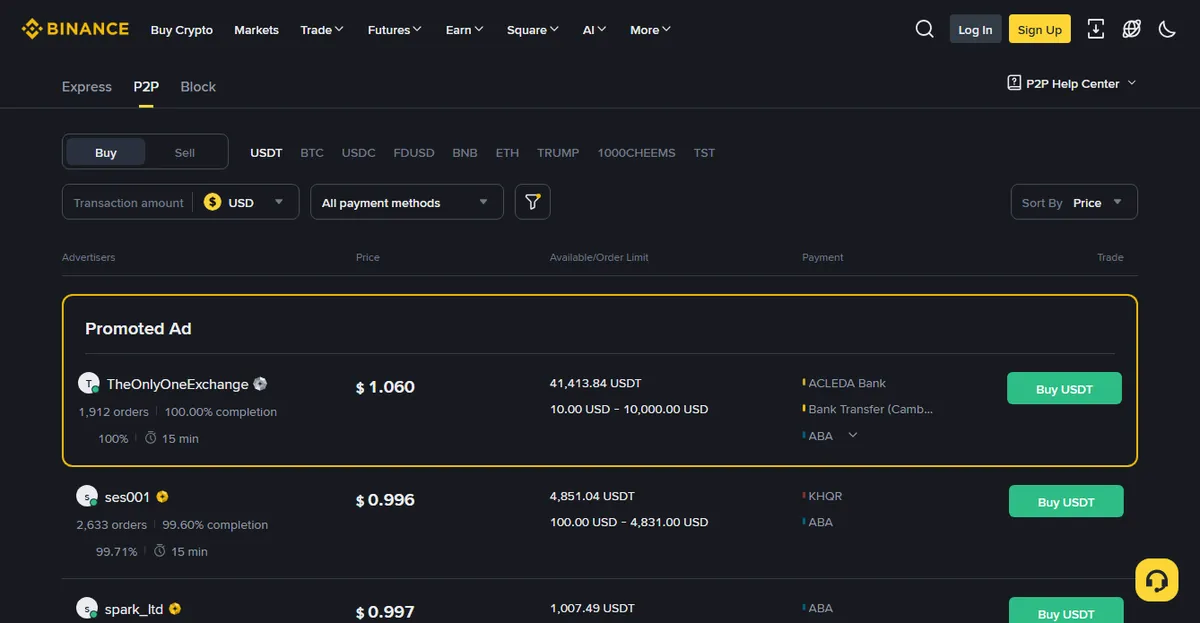
Start with what that screenshot demonstrates, because it is the most useful single observation on this page: the top row is frequently not the best price. It is a paid placement. Sorting by price and reading the rows underneath the promoted slot is a free improvement worth making, because the eye tends to treat the first row as the recommendation.
What escrow protects, and what it does not
The mechanism is narrower than it first looks, and knowing the boundary is what tells you where your actual exposure sits.
What it does: from the moment an order opens, the crypto is locked by the platform. The seller cannot spend it, cannot cancel it away, and cannot disappear with it. When the order completes, the platform releases it to the buyer. That much is genuinely protected.
What it does not do: the local-currency leg happens entirely outside the platform, between your bank account and theirs. The platform never sees that money, cannot hold it, and cannot reverse it. Everything that goes wrong in P2P goes wrong on that side.
So the two sides face different risks, and it is worth being explicit about which one you are on.
- Buying crypto: you pay first, and the escrow is holding what you are owed. Your risk is a counterparty who does not release, which is a dispute — annoying, slow, usually resolvable, because the evidence is a bank record you can produce.
- Selling crypto: you release an asset that cannot be recalled, in exchange for money that can be. Your risk is not just non-payment; it is payment that arrives, is credited, and is later reversed or flagged upstream. That is the exposure behind almost every restricted-account story, and it is why the selling side deserves the caution.
The numbers, ranked by how much they tell you
Order count — the most informative
The number of completed trades. This is closest to a track record: it takes time to accumulate, and it cannot be manufactured cheaply. A counterparty with thousands of completed orders has a business that would be damaged by defrauding you over one trade. One with eleven has nothing at stake.
It is not proof of anything — an account can be sold or compromised — but of the figures on the screen, it is the one that costs the most to fake.
Average release time — informative, and undervalued
How long the counterparty typically takes to release the crypto after payment. It matters more than people expect, because that interval is when your money has left and you have received nothing. A counterparty who releases in minutes is operating a real process. One with a long average is either slow, or working with a rhythm that will leave you refreshing the page.
In the screenshot every visible row shows the same short window, which is normal for high-volume sellers — the number becomes discriminating at the other end of the list.
Completion rate — weaker than it looks
Here is the misreading. Completion rate is the proportion of initiated orders that completed, and it is dominated by buyers who opened an order and walked away, which is extremely common and says nothing about the seller. A busy, entirely legitimate counterparty will have a rate below 100% for reasons that have nothing to do with them.
What it is good for is the extreme tail. A rate that is very low is worth avoiding. The difference between 99.6% and 100% is noise, and treating it as a ranking is how people talk themselves into a worse price for no gain.
Price — informative, and the trap
The best price on the screen is frequently attached to the counterparty you least want. That is not a coincidence; an unusually good rate is the cheapest way to attract orders.
Our position, stated plainly: a fraction of a percent is not worth transacting with an unknown counterparty. If the top listing by price has a hundred orders and the third listing has eight thousand, take the third. The spread you give up is small and bounded; the downside you are avoiding is neither.
Verification badges — near-zero on their own
Badges indicate that the counterparty completed some process on the platform. They tell you nothing about the money they will send you, which is the actual risk. Read them as a floor, not a signal.
The payment method is the real decision
The listing's payment methods deserve more attention than any of the numbers, and for the opposite reason people usually look at them.
When you are selling, the payment method determines which of your accounts receives money from a stranger — and therefore which account is exposed if that money turns out to have a problem upstream. That is the mechanism described in cash in and cash out, and it is the main reason people end up with a restricted account.
Two rules follow, and they are not negotiable:
- The paying name must match the counterparty's verified name. Payment from a third party is a hard stop — it breaks the correspondence between the platform's record and your bank's record, which is precisely the correspondence you would need later to explain the transfer. Do not release, and raise it with the platform.
- Say what the transfer is, truthfully. We used to advise keeping crypto out of the reference field so it would attract less attention. That was advice about appearances, and we have dropped it. Fill the field honestly, or leave it to the platform's own flow, keep the matching order record, and give the same account of it to anyone who asks.
When you are buying, the same field matters for a duller reason: pick a method you can actually complete quickly, from an account in your own name. A method that takes you an hour to set up is an hour of price exposure and an hour of the counterparty waiting to cancel.
Limits, windows and cancellations
Three mechanical details that cause most of the avoidable friction.
- Order limits are a range, not a maximum. Each listing states a minimum and a maximum, and an amount below the minimum cannot be filled at all. Check the range before opening rather than after, because a cancelled order counts against the completion rate on both sides.
- The payment window is a countdown, and it starts when the order opens. Not when you start the transfer. If your bank has a cooling-off period on new payees, or you are trading outside banking hours, the window can expire while a legitimate transfer is in flight — which is the most common way an honest trade turns into a dispute.
- Cancelling repeatedly has consequences. Most platforms restrict accounts that open and abandon orders, because from the other side that behaviour is indistinguishable from time-wasting. Filter before you open.
Practical version: decide the amount, confirm your payment method is ready and reachable right now, then open the order. The order is the last step, not the first.
The rule that outranks all of it
Everything above is optimisation. This is the part that determines whether you lose the money:
Payment and release both happen inside the platform's order flow. That is what escrow means: the crypto is held by the platform from the moment the order opens, and released when the order completes. Step outside the flow and there is no escrow, no record, and no dispute process — you are wiring money to a stranger on the internet.
The scripts that get people out of the flow are worth knowing because they do not sound like fraud:
- "The platform is having issues, let us just do this directly."
- "Mark it paid first and I will release immediately, we can save time."
- "Cancel and I will send you a better rate on Telegram."
- "I have sent it, here is the receipt" — with an image, before anything has arrived.
The last one is the most effective, because a screenshot of a payment is trivially forged and looks exactly like proof. Confirm receipt in your own banking app, on the balance, before releasing. Not in a notification, not in a message, not in an image. Pending is not received, and a transfer can be recalled after it appears.
When it goes wrong: the dispute
A dispute is an appeal to the platform to decide who is right, using the evidence each side supplies. It is not a support conversation and the tone of your messages does not affect it. What affects it is documentation.
What is worth having ready, whichever side you are on:
- The bank record showing the transfer, with the amount, the timestamp and the names on both ends. A statement line beats a screenshot of a confirmation page, because it shows the money moved rather than that an instruction was given.
- The order reference from the platform, matched to that transfer.
- The in-order chat, which is why all communication belongs there rather than on a messaging app. A conversation the platform cannot see is a conversation that did not happen.
Two things that go badly. Releasing under pressure while a dispute is open ends it in the other party's favour permanently — there is nothing to appeal once the asset is gone. And accepting an offer to "settle it privately" moves the whole matter outside the only process that could have helped you.
Realistic expectations: disputes are measured in days, the platform decides on evidence rather than on sympathy, and the outcome for a seller who released before confirming receipt is almost always the same one.
The order of operations
- Sort by price, then read past the promoted row.
- Filter to a payment method you can complete from an account in your own name.
- Among what is left, prefer high order count and short release time. Ignore small differences in completion rate.
- Check the order limits before opening — a listing you cannot fill wastes both parties' time and counts against the completion rate you were just reading.
- Open the order and complete payment within the window, entirely inside the platform.
- If selling: confirm the funds are actually in your balance, from the matching name, before releasing.
- Keep the order record. Export it periodically. Future-you may need it, as described in cash in and cash out.
Quick answers
Is P2P safe?
The escrow makes the crypto leg safe. The money leg is an ordinary bank transfer with a stranger and carries ordinary bank-transfer risk, which is concentrated on the selling side. Whether that is acceptable depends on the alternatives available in your market.
The counterparty says they have paid but nothing has arrived. What now?
Do not release. Check your own balance in your own banking app, not a screenshot and not a notification. If the window is expiring and nothing has arrived, open the dispute — that is what it is for, and opening it does not accuse anyone of anything.
Someone paid from a different name. Is that a problem?
Yes, and it is a hard stop. Do not release, and raise it through the platform. A third-party payment breaks the correspondence between the platform's record and your bank's record, which is exactly the correspondence you would need later.
Why is the top listing more expensive than the ones below it?
Because it is often a paid placement rather than the best offer. Sorting by price and reading past the promoted row is the single cheapest improvement available on that screen.
Sources
- Binance P2P, merchant programme page — the published definition of the verified, shield and pro merchant badges and what each one requires. What a badge means comes from here, not from someone's forum post.
- Binance help centre, how to become a Binance P2P merchant — the deposit a merchant has to post and how completion rate and release time are counted. How those numbers are computed is what decides what they can tell you.
The merchant tiers and their thresholds are set by the platform, they change, and availability differs by market. This page is about reading the numbers; it does not vouch for any individual counterparty.