
What the number is made of
Three quantities determine where the line sits, and only one of them is the one people think about.
- Position value. What you control, not what you paid. At twenty times leverage, a thousand of margin controls twenty thousand of position.
- Your margin. What you actually put up, plus or minus everything that has happened since — unrealised profit and loss, funding, fees, and any margin you added or removed.
- The maintenance requirement. A percentage of position value that must remain as margin. Fall to it and the position is closed.
The common mental model — "I lose my margin, then I am out" — assumes the third term is zero. It never is. The position is closed while there is still margin left, precisely so that there is something left to close it with.
Think of it as a floor rather than a cliff. Your margin sits on top of the floor; the fall you can absorb is the distance between them, not the whole height.
The maintenance margin, and why it is not a constant
The requirement is a rate applied to position value, and it varies. Two things move it, and both work against you in exactly the situations where you would prefer they did not.
- Position size. Larger positions sit in higher brackets with higher maintenance rates. The platform is pricing the fact that a large position is harder to close without moving the market.
- The instrument. More volatile and less liquid contracts carry higher rates than the major pairs.
The bracket structure is what catches people. Because the rate steps up as you cross size thresholds, adding to a winning position can push the whole position into a higher bracket, which raises the requirement on all of it and moves the liquidation line closer even though you just added margin. This is not a bug and it is not hidden — it is on a public page — but it is not intuitive, and it is the mechanism behind a lot of "I added funds and it liquidated anyway".
Reading a real bracket table
Every venue publishes its brackets. It is worth looking at one, because the shape of the ladder tells you more about leverage than any explanation does.
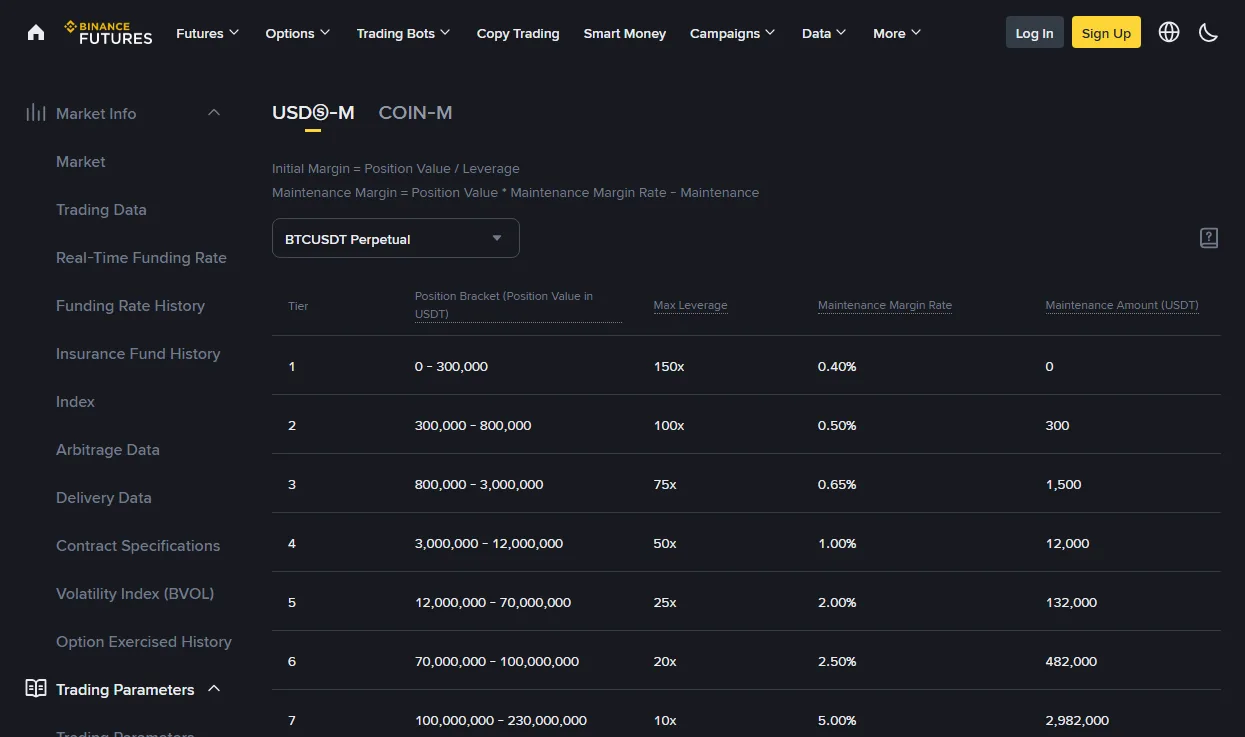
Three readings worth taking from a table like this. First, the maximum leverage advertised for a contract applies only to the smallest bracket — it is not available at size, and a headline leverage figure is a statement about small positions. Second, the maintenance rate at the top of the ladder is many times the rate at the bottom, so the same percentage price move is survivable at one size and not at another. Third, the "maintenance amount" column is a subtraction that makes the steps continuous rather than jumping; it is bookkeeping, not a discount, and it is why hand-computed liquidation prices rarely match the platform's to the decimal.
Which price triggers it
Not the last traded price on the order book. Most venues trigger against a mark price, which is derived from a wider index of spot markets and smoothed to resist manipulation on any single book.
This is a protection and it usually works in your favour: a momentary wick on one exchange does not liquidate you if the index did not move. But it cuts both ways. The mark price can drift toward liquidation while the chart you are watching looks calm, and it can trigger a close at a level the visible price never printed. If you are going to argue with a liquidation, check the mark price history first — that is the number the system used.
The liquidation estimator works on the same inputs and is a planning tool: it tells you roughly where the line sits before you open, which is when the information is still useful.
Cross and isolated fail differently
- Isolated margin. Only the margin assigned to that position is at risk. The line is closer, because there is less behind it, and the failure is contained: that position closes and everything else in the account is untouched.
- Cross margin. The whole available balance backs the position. The line is further away, which feels safer and is the reason people choose it. What it actually means is that a single position can consume the entire account, and that positions stop being independent — a losing trade draws on the margin that was holding up the others.
Neither is safer in general. Isolated fails small and often; cross fails rarely and totally. Choosing between them is choosing which of those two shapes you would rather live with, and the honest default for anyone still learning the mechanism is isolated, because it makes the worst case knowable in advance.
Why the line moves while you hold
Four things move it after entry, and none of them announce themselves:
- Funding payments on perpetual contracts, deducted from margin at each settlement. Slow, relentless, and the most common cause of an unexplained shift. See the funding rate for the mechanism.
- Fees on every adjustment you make, including partial closes.
- Adding to the position, which raises position value and can push you into a higher maintenance bracket.
- Moving margin out of an isolated position, or opening another position on cross, both of which reduce what is standing behind this one.
The consequence is simple and widely ignored: the liquidation price you noted at entry is a fact about that moment. If the position is still open two days later, recompute it rather than trusting the number in your notes.
What actually happens during a liquidation
It is not a single instant. On most venues the sequence runs: the maintenance threshold is breached, the position is taken over by the liquidation engine, and the engine attempts to close it on the open market. If it closes better than the bankruptcy price, the remainder may go to an insurance fund; if it closes worse, the insurance fund absorbs the shortfall.
Two practical consequences. First, there is usually a liquidation fee, so the amount returned to you is less than a naive calculation suggests — which is why people find their remaining balance lower than expected. Second, in extreme conditions where the insurance fund cannot absorb the shortfall, some venues socialise the loss across profitable traders on the other side, a mechanism usually called auto-deleveraging. If you have ever had a profitable position closed without asking, that is what happened.
None of this is negotiable afterwards and none of it is reversible. A liquidation is an automated process completing correctly, not an error to be appealed.
What leverage actually buys you
Leverage does not increase your expected return. It scales both outcomes and, critically, it shortens the distance to the point where you are removed from the trade entirely.
Roughly, the price move that liquidates you is the inverse of your leverage minus the maintenance requirement. At five times, you have most of a twenty percent move to work with. At fifty times, you have most of two percent — which is inside the ordinary daily range of most crypto assets, meaning liquidation is not a tail event at that setting, it is the base case.
Which reframes the choice. High leverage is not a way to make more from a correct view; it is a way to be removed from a correct view by ordinary noise before it plays out. The useful question when sizing is not "how much can I control?" but "what price move ends this position, and does that move happen on a normal Tuesday?"
Habits that keep the line visible
- Compute the liquidation price before opening, not after. Afterwards it is information you cannot act on calmly.
- Write down the price move it represents as a percentage, and compare it to the contract's ordinary daily range. If it is inside that range, the size is wrong.
- Re-check it every day the position stays open. Funding has been working the whole time.
- Set your own exit above the liquidation line. A stop you chose is an exit; a liquidation is an eviction, and it costs more.
- Treat adding margin as a decision, not a reflex. Adding to defend a losing position converts a bounded loss into a larger one, and the bracket effect can move the line against you at the same time.
Questions people ask afterwards
Why was I liquidated when the price never reached my liquidation price?
Almost always the mark price versus the last traded price. The system uses the mark, which is derived from a broader index. Check the mark price history for the moment in question before concluding anything went wrong.
Why is there money left in my account after a liquidation?
Because the close happened at the maintenance threshold rather than at zero, and whatever remains after the liquidation fee and the closing execution stays yours. The amount is often smaller than expected because of that fee.
Can I stop a liquidation once it starts?
No. Once the engine has taken the position, adding margin does not return control. Margin has to be added before the threshold is reached, which is a reason to watch the line rather than the price.
Does a stop-loss protect me from liquidation?
It helps, and it is not a guarantee. A stop is an order that has to fill, and in a fast gap it can fill well below its trigger — potentially past the liquidation line. Size is the protection; the stop is the plan.
Is isolated margin always safer than cross?
It is more predictable, which is not the same as safer. Isolated caps the loss on one position and liquidates sooner. Cross survives longer and can take the whole account. Predictability is worth a lot while you are still learning the mechanism.
Why did my liquidation price get worse after I added to the position?
The bracket effect. A larger position can fall into a higher maintenance-rate tier, and the higher rate applies to the whole position rather than only the new part. Check the bracket table before adding size near a threshold.