The answer, before the detail
Closing your account and deleting your verification data are two different requests. They run through different processes, and they are governed by different rules.
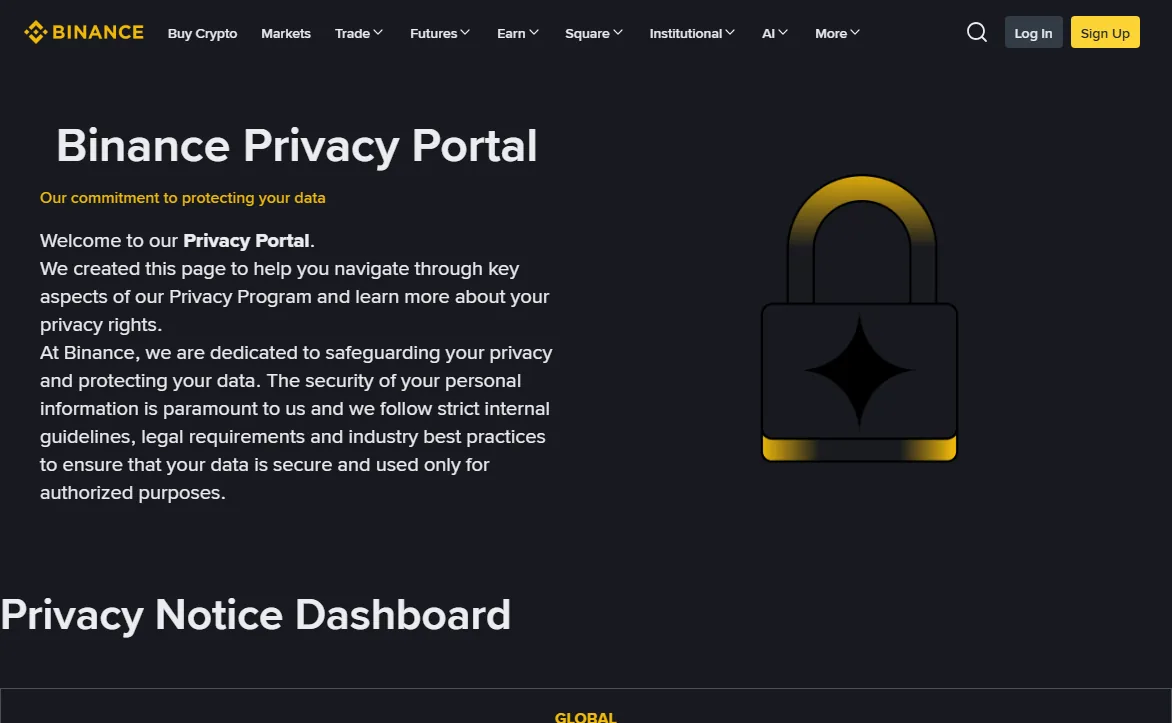
Binance's own Privacy Portal is fairly blunt about it. Under the heading "Can I request the deletion of my data?", the first sentence grants you the right to deletion, and the second takes part of it back: these rights are subject to limitations. It then names what is limited — financial transaction details, information related to identity verification processes, and information related to anti-money laundering measures. The verb it uses is compel: legal and regulatory requirements compel the platform to keep these "for a specified period".
The same section says what can go. Anything not explicitly required to be kept under applicable law is deletable on request, and it gives two typical examples: data used for marketing, and data tied to additional services you signed up for.
That shapes how this site treats ID scans and face videos: assume that once submitted, they stay with the exchange for a long time, and make the decision before you press submit rather than counting on a deletion request to undo it later. This is not a verdict on Binance in particular. Any exchange working under anti-money-laundering rules is in the same position.
Two piles of data, and which one you can empty
Sorted by whether a request from you can remove it
- Usually deletable → marketing preferences, notification subscriptions, and data from add-on services that no law specifically requires them to keep
- Usually not deletable → what the document and face checks produced, anti-money-laundering records, and the record of your transactions
- Who drew the line → the portal points to legal and regulatory requirements, not a commercial preference
- Not forever, though → the wording is "a specified period"; there is a limit, it is just written down somewhere else
Where a deletion request actually goes
There are two places where these requests are handled. Anything that claims to be a third is the thing to be wary of.
The Privacy Center inside your account
The portal says it is "located on the 'settings' tab of your account". Getting a copy of your data, correcting details you entered wrongly, and deleting the account are all self-service there; nobody has to approve them first. If the Privacy Center can do it, do it there instead of opening a ticket — a ticket only adds a step between you and the same button.
The DPO Team, by email
For the rights the Privacy Center does not cover — objecting to processing, restricting it, portability, and getting at the verification material itself — the portal sends you to the Data Protection Officer team. It offers this as an email link rather than a printed address, so click through from the portal page itself instead of copying an address from a forum post. A request sent to the wrong inbox simply never arrives. If you get stuck, the same part of the page says customer support agents can help through the support chat.
2026-10
The third route that does not exist
Anyone who messages you on social media offering to "clear your KYC record" cannot do it. The exchange itself cannot erase that record on demand, so an outsider certainly cannot. What they want is access to your account, or a fee. The settings in the account security article are what stands between you and that kind of approach.
After you send it: an identity check, a wait, and a split answer
First, you will be asked to prove who you are. The portal states that, to proceed, they will need to verify your identity by requesting some documentation based on what they already hold. Handing over documents in order to have documents deleted sounds circular. Consider the alternative, though: without that check, anyone who got into your email could have your records removed in your name.
Then the wait. For requests under GDPR, the portal's stated limit is up to one month. For other jurisdictions it says the deadline "may be different depending on the local laws" — that qualifier is theirs, not ours.
The reply is rarely all or nothing. Do not expect either "everything has been erased" or "request refused". The likelier outcome is a split: the first pile is removed, the second is kept, with the legal basis for keeping it.
How long Binance keeps KYC data, and why there is no number here
If you searched for a retention period, a figure in years is what you came for. This page does not give one. The reasoning is below, and you can judge whether it holds.
Three things can be stated with confidence.
The Terms of Use hand the number to the law
In the Chinese-language Terms of Use, clause 7.5 is titled "Records" and says Binance keeps your personal data to meet the purposes in the Privacy Notice and requirements such as tax and accounting law and anti-money-laundering law. Clause 8.1 is more specific: Binance may keep the information for as long as your Binance account exists, "or such other period required by applicable law". That last phrase is where the answer lives. The Terms do not set a period; they defer to whichever law applies to you. The page shows a last-updated date of 31 August 2023.
The Privacy Portal does not give one either
Its section "For how long does Binance retain my data?" lists the reasons for keeping data — tax, accounting, anti-money laundering, disputes and legal claims — and then directs you to the privacy notice that applies to you.
There is more than one privacy notice
The Privacy Notice Dashboard at the top of the portal is a list of versions. Alongside the global one there are separate notices for Australia, Japan, New Zealand, France, Italy, Poland, Portugal, Spain, the UK, Argentina, Brazil, Mexico, the rest of Latin America, Bahrain, Dubai and Kazakhstan. A retention period someone quotes online may come from a notice that does not cover you at all.
Put together, the useful question is not "how long does Binance keep it" but "which notice applies to me, and what does that one say". We have not opened and compared the retention clauses in all of those regional notices, so there is no number on this page. A half-checked figure printed here would be read as the answer for everyone, which is worse than leaving the space empty.
If you want it deleted because verification was rejected
Sometimes "can I delete my KYC data" really means "can I wipe the failed attempt and start verification over". That is a different problem, and deletion is not the tool for it.
The portal is candid on this point. Under "Is it possible to contest automated decisions?" it confirms that onboarding uses automated decision-making: the documents, photo and live video you send are checked by automated means to meet anti-money-laundering rules worldwide. It also admits the process is not perfect, and gives an example — twins opening separate accounts can look to the system like one person registering under two names.
What it offers in response is an appeal with a human review, not a reset. The steps it lists: sign in on the app or the website, go to your profile, tap the headphone/chat icon, choose "View more" in the Self-Service section, scroll to the KYC section, and pick "Failed Facial Verification Appeal" or "Appeal KYC Rejection". The request goes to a KYC support agent for manual review.
Note the wording on those two options. They say "appeal", not "verify again" — look through the support menu for a retry button and you will not find one.
Why the check failed, and whether to change the device, the lighting or the document next time, is covered in identity verification keeps failing. Its advice to change one condition at a time before each retry works well alongside the manual review route described here.
One more case. If you have not opened an account yet and are still deciding whether to hand these documents over, you are at the point where you have the most control over all of this. Before submitting, you can take as long as you like; afterwards, all that is left is a request and a wait. The account opening guide covers preparing documents, which is a sensible place to check what ID and proof of address you could actually provide.
Sources and notes
- Binance Privacy Portal — all quotations in this article come from this page, specifically the sections "For how long does Binance retain my data?", "What support does Binance offer to help me exercise my rights?", "Can I request the deletion of my data?" and "Is it possible to contest automated decisions?". Checked 2026-10-04.
- Binance Terms of Use, Chinese-language edition, clauses 7.5 (Records) and 8.1 — the reasons for retaining personal data and the "other period required by applicable law" wording come from here; the English renderings above are ours. The page shows a last-updated date of 2023-08-31; clause 8.1 checked again on 2026-10-04.
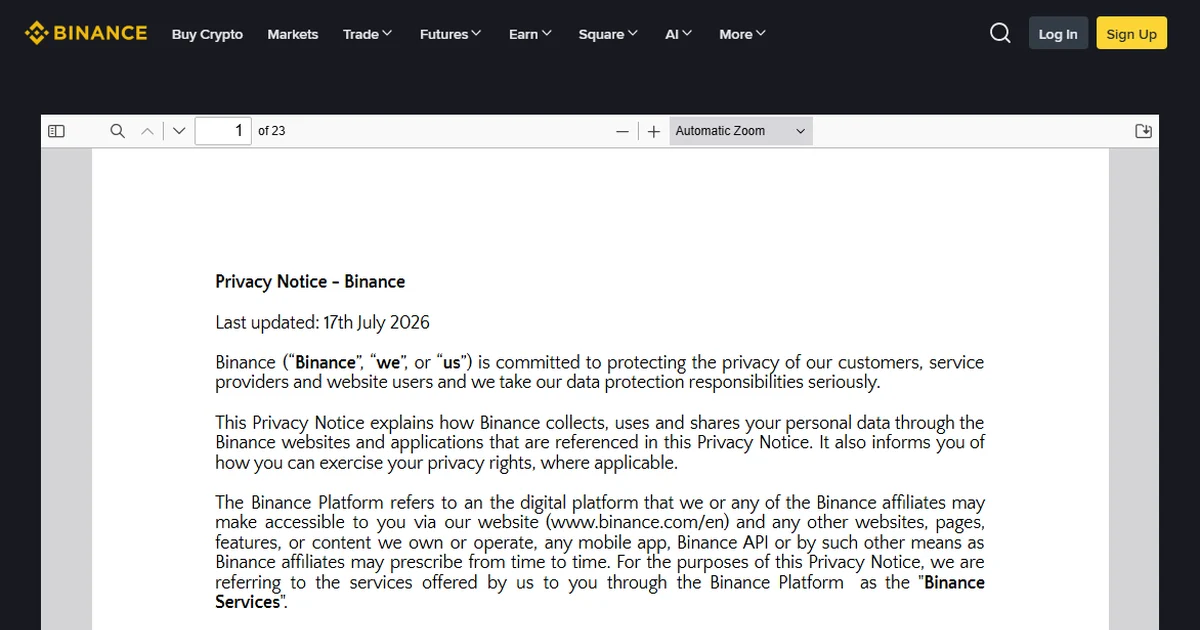
- Binance Privacy Notice — the global notice embedded on this page is marked last updated 2026-07-17 and runs to 23 pages; regional versions are linked from the Privacy Portal. The cover image is this page.
- No retention period appears anywhere in this article, deliberately. The reason is in the section on why there is no number. If you see a figure quoted elsewhere, first establish which privacy notice it comes from and whether that notice covers where you live.
Data protection law varies a great deal between jurisdictions. The documents above show where the rights and obligations come from; they are not a substitute for a local lawyer looking at your situation. If something on this page is wrong, tell us through the contact page; confirmed fixes go in the corrections log.
Quick answers
Does deleting my Binance account delete my KYC documents?
No. Account deletion ends your use of the service. Binance's Privacy Portal says legal and regulatory requirements compel it to keep identity verification information, anti-money-laundering records and transaction details for a specified period, so those stay after the account is closed.
How long does a data request take to get an answer?
The Privacy Portal says up to one month for requests exercising GDPR rights, and that the deadline may be different in other jurisdictions depending on local law. Before anything is processed you will be asked for documents to verify your identity.
Can someone pay to have my KYC record cleared so I can verify again?
No. Binance itself is required to keep that record, so nobody outside can remove it. A rejected verification is handled through the Failed Facial Verification Appeal or Appeal KYC Rejection options in the support menu, which send the case to a human reviewer.